
Selection and preparation of ingredients, including meats, seafood, vegetables, and cheeses
Food selection
Selecting food always requires great care. In order for each dish to be impeccable in every aspect, it is often not enough to generically list the food items needed for its preparation. This is because different cuts of meat, types of apples, varieties of carrots, types of paprika, flours, pasta shapes, and other ingredients all have different characteristics. It also matters when a particular type of vegetable or fruit was harvested, and if it is not fresh, how it was treated and stored. Additionally, the shape, size, and structure of a given food item should be taken into consideration. All of this underscores the need for precise knowledge of the foods, the dish to be prepared, the preparation process, and the cooking process in order for someone to select the most suitable ingredients for a particular dish.
Decide whether the following statements are true or false.
- We don’t have to be really careful when choosing food.
- True
- False
- It is usually enough to name the food materials necessary for their preparation in general terms.
- True
- False
- The individual raw materials – such as individual parts of meat, types of apples, carrots, hot peppers, flours, rolled pasta – have different properties.
- True
- False
- When choosing, it does not matter when a vegetable or fruit was produced, how fresh it is or how it was handled and stored.
- true
- false
- When selecting the raw material, the shape, size, and structure of the given food must also be taken into account.
- true
- false
- Accurate knowledge of the food, the food to be prepared, the preparation and preparation is also necessary in order for someone to select the most suitable ingredients for a given dish.
- true
- false
Ingredients for Hot Appetizers
Cooking methods used for hot appetizers, including baking, frying, and grilling
The work process of preparation
In this unit, we will talk about what and how, i.e. with what foods, what actions and steps you have to perform during the preparation of warm tasting food.
The preparation of food consists of two well-defined but closely connected and interdependent sub-processes and an additional sub-process. Food must first be prepared (sorted, washed, peeled, chopped, etc.), followed by the preparation (roasting, steaming, baking, cooking, steaming) and the additional (furring, thickening, flavoring, seasoning, filtering, etc.) ) operations. Of course, the preparation must be preceded by the selection, procurement, storage and purchase of food. In the case of hot appetizers, after the preparation and additional operations, the dishes must be kept warm according to their nature, which is followed by the tasteful serving and decoration.
In order to master the preparation of a dish, you need to know what raw materials, with what tools, in what order and what to do, i.e. what actions and steps to perform. Establishing the appropriate sequence is also the basis for planning and organizing the work to be performed.
However, theoretical knowledge is only a prerequisite for successful food preparation. After all, how to perform operations and moments can only be learned in practice. In addition, the knowledge continues to expand and deepen during the practical work. With the help of our senses, with different perceptions (sight, touch, smell, taste, hearing), we get information that cannot be known in theory. When it is properly salty, sweet, sour, hot, lukewarm, or when it is soft/hard, small/large, proportional/disproportionate, thick/thin, thick/thin, etc. something we can only properly know if we experience it personally. Observing and persistently practicing professionally performed movements, collecting, analyzing, and evaluating experiences throughout our lives leads to the ability to make the food we prepare bring joy.
- Description of the task:
Match the listed sub-processes to the appropriate group!
- Appearance of the task:
https://learningapps.org/create?new=86#preview
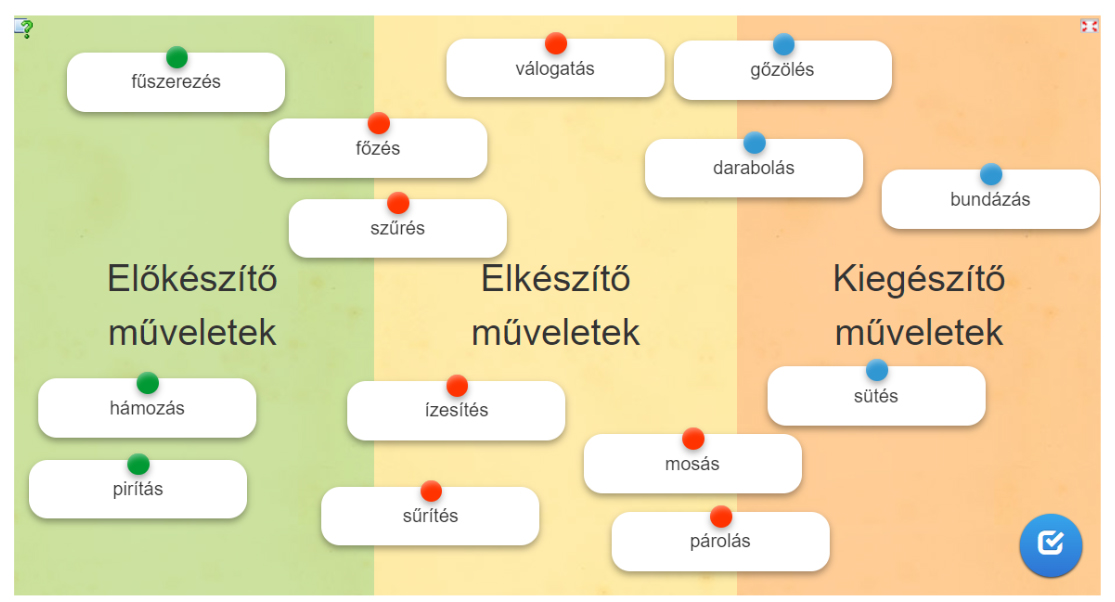
3. Text part of the task / Solution of the task:
Preparatory operations: sorting, washing, peeling, cutting
Additional operations: furring, thickening, flavoring, seasoning, filtering
Learning outcomes/results (ECVET)
|
You know the basic aspects of food selection. |
|
He/She understands the processes of food preparation and knows how to define the processes organically! |
|
He/She is aware of the preparatory operations, knows his role and characteristic operations. |
|
He/She is aware of the preparation operations, knows his role and characteristic operations. |
|
You are aware of additional operations, know its role and characteristic operations. |


