
You welcome!
In this module we will take a look at condensed soups.
Definition:
Condensed soups are liquid culinary preparations with increased density due to the preservation of vegetables in the preparation and after thermal processing.
Examples of condensed soups from our project
-Bean soup with smoked ribs (RO)
– Potato soup with tarragon (RO)
-Soup with stuffed peppers (RO)
The general technology of obtaining these soups generally respects the technology of obtaining soups, with the following stages: checking the quality of the raw materials, dosing the components, preparatory operations, preparing the additional elements, heating the bone soup, boiling and serving.
In these types of soups, the vegetables are boiled in bone broth, adding a new amount of soup as needed. Add the additional elements and continue boiling for another 10 minutes to even out the taste.
As an additional element, the composition consisting of flour, cream, egg yolk is used, which is thinned with cold soup, mixing continuously for a good homogenization.
Creams are thickened soups obtained by pureeing heat-processed vegetables, mixed with the cooking liquid. Vegetable creams contain at least two vegetables, the onion and the basic vegetable, which gives the cream its name.
Examples of cream soups cream soup of mushrooms, cauliflower, peas, etc.
The tasks will help you develop a good understanding of the following:
What is a condensed soup?
Name three condensed soups from our project.
What is the main difference between clear soup and a condensed (thickened) soup?
What does the thickening mixture contain?
What is the difference between cream and thickened soups?
Enjoy the mod!
Knowledge: Students know the concept of condensed soup.
Skill: Students have the ability to recognize types of condensed soups.
Attitude: Students respect sustainable principles in safe and secure work conditions.
Responsibility: Students respect the norms of ethics in collaboration with colleagues.
Evaluation – solving work tasks
Documentation of learners
Validation and recognition mechanisms
During the lesson you must read the written explanations and follow the instructions given to the interactive elements.
Introduction to condensed soup recipes
Definition of condensed soups
Read the above material carefully and answer the following questions:
What are condensed soups?
What components does the binding mix have?
What are cream soups?
Characteristics of the varieties of condensed soups
After you have read the theoretical part, in the table below mark X in the correct answer column for the following questions:
|
Question |
Answer YES |
Answer NO |
|
1.Is dumpling soup a condensed soup? |
||
|
2.Does tarragon potato soup contain flour? |
||
|
3.Does the binding mix contain yogurt? |
||
|
4.Is the thickened soup a cream soup? |
- Culinary technology, textbook for grades X-XII, didactic and pedagogical publishing house, Bucharest, 2020.
– Tourism and food, textbook for the 10th grade, CD Press publishing house, Bucharest, 2021.
Practical experience in making condensed soups
Soup with stuffed peppers
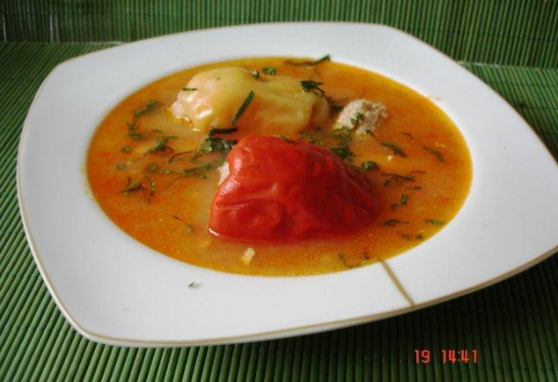
Raw materials
Minced meat, a mixture of beef and pork – 1 Kg
Rice – 150 g
Onion- 200 g
Eggs- 2 pieces
Pepper – 30 g
Paprika – 30 g
Carrot – 200 g
Parsley root – 200 g
Celery- 100 g
Small bell peppers – 20 pieces
Green parsley – 50 g
Oil – 100 ml
Flour- 40 g
Tomato juice – 1 l
Sour cream- 300 g
Salt
Preparation technique
Root vegetables: carrot, parsley and celery, wash, clean, wash and cut into 4, boil in a pot of water. Wash the peppers and remove the stem and seeds. Clean, wash and finely chop the onion and green parsley.
In a bowl, mix the minced meat, eggs, onion, rice washed in several waters, salt, 1/2 of the paprika and pepper. Fill the peppers with this composition and put them in the pot to boil together with the root vegetables.
After about an hour, when the stuffed peppers have cooked, a Romanian sauce is prepared (as in Transylvania): heat the oil, add the flour, stirring continuously so as not to burn, and when the color changes, add the rest of the paprika pepper, salt and tomato juice. Bring to a boil, then pour over the pepper soup from the pot. Boil for another 2 – 3 minutes to homogenize the taste.
The soup is served on a plate (with twostuffed peppers), sprinkle green parsley on top and serve with sour cream.
Potato soup with tarragon
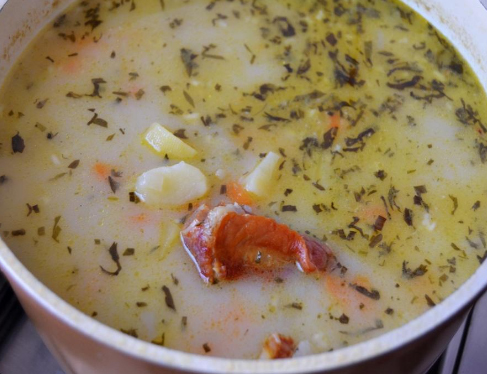
Raw materials
Potatoes- 2 Kg
Onion- two pieces
Tarragon preserved in vinegar- 70 g
Egg yolk- two piece
Smoked pork- 500 g
Sour cream- 300 g
Flour- 100 g
Vinegar- 80 ml
Salt
Preparation technique
Boil the smoked meat in 4 liters of water and let it foam.
The peeled, washed and diced potatoes, the peeled, washed and finally chopped onions and salt are added over the meat and the cooking is continued.
Mixthe yolks with the cream and flour diluted with vinegar and put on top of the soup. At the end, add the tarragon and let it boil for another 3 minutes.
Bean soup with smoked ribs
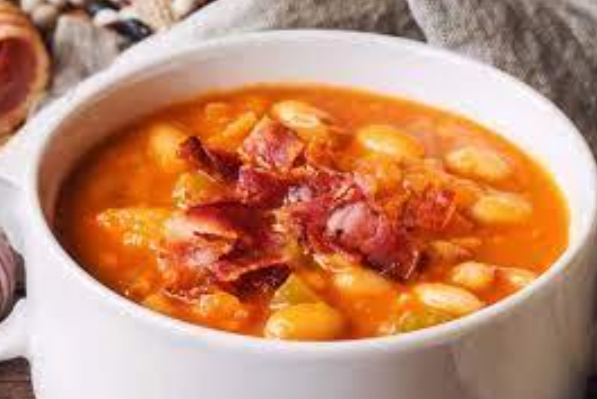
Raw materials
Smoked ribs – 250 g
Beans 750g
Carrot – 100g
Parsnip – 100g
Tomatoes – 500g
Peppercorns – 20g
Sugar -25 g
Paprika – 20 g
Red onion- 150 g
Celery- 50 g
Broth – 200 g
Oil – 100 ml
Apple or wine vinegar -100 ml
Fresh tarragon-10 g
Fresh thyme – 10 g
Preparation technique
The onion is cleaned, washed, finely cut and scalded. Root vegetables (carrot, parsley, parsnip, celery) are washed, cleaned, washed and cut into cubes. The tomatoes are washed, scalded, peeled and cut into large pieces.
The beans are washed, left to soak for at least 6 hours and boiled in salted water.
The smoked rib is cut into pieces and sautéed in oil. It is taken out of the pan and then stew the vegetables in the remaining oil, then add water, the diluted broth and continue boiling until the vegetables have softened. Add the beans, the ribs, the spices, a part of the thyme and tarragon and the vinegar and continue boiling for another 10 minutes to even out the taste.
The soup is presented in a bowl or mug and served warm with thyme and tarragon sprinkled on the surface.
Technical characteristics in obtaining condensed soups
After carefully reading the grids given above, add the missing words replaced by the dotted lines and that match so that the sentences make sense.
Replace the dotted lines with the correct words in context:
Clean, …………… and finely chop the onion.
If the condensed soup contains …………., wash it several times in water.
In condensed soups with meat and vegetables, the meat is partially thermally processed and then the ……………….. are also introduced into the thermal process.
The beans are left to soak in water for …….. hours and boiled separately until ……………. cooked.
Flour mixed with other ingredients is used to ……………… condensed soups.
Flavors and colors of condensed soups
Below are statements regarding the seasoning and coloring of condensed soups.
Mark T next to the statement you consider true and F next to the statement you consider false.
The potato soup is seasoned with tarragon.
The spices used in “Bean Soup with Smoked Chives” are thyme and tarragon.
Condensed soups are seasoned at the end of the thermal process or directly on the plate.
Condensed soups are colored with paprika, tomato paste and broth.
Learning outcomes/outcomes (ECVET)
|
Knowledge |
Abilities |
Attitude |
Responsibility |
|
Characterization of the raw materials needed to make condensed soups Description of operations for obtaining condensed soups. Description of the rules for seasoning, assembly and presentation of condensed soups. |
The student processes the collected information to use it in fulfilling the tasks of making condensed soups. The student performs the operations of obtaining liquid preparations and spices them accordingly. The student assembles the liquid preparations into inventory items characteristic of these preparations and decorates accordingly. |
The student has a positive emotional attitude that is determined by inner motivation, showing interest in making condensed soups in compliance with labor protection and hygiene norms, with responsibility for environmental protection |
In his attributions to solve work tasks, the student makes decisions independently, respecting the rules of ethics and taking into account professional principles.
|


