
You welcome!
In this module lesson we will take a look at cutting techniques and other operations performed on ingredients used to obtain liquid preparations. Both cleaning, cutting and other preliminary processing operations of the raw materials used to obtain liquid preparations are considered.
The tasks will help you understand the techniques of cleaning, cutting and other operations of preparation of raw materials to be added to the thermal processes of obtaining liquid preparations as well as the way of execution with the help of utensils/equipment, helping you to answer the questions as well as understanding the partial, total thermal processes and other operations that are carried out on the ingredients in order to obtain the soups. That way you will be able to answer the questions
- In which premises are the primary processing operations for vegetables, greens, meat, cheeses and spices carried out?
- How to clean vegetables and with what utensils/equipment?
- How to cut vegetables, greens, meat, meat dishes, cheeses and with what utensils/equipment?
- What preliminary operations are done on the raw materials before they are introduced into the heat treatment?
- What partial and total thermal processes are done on the raw materials to obtain the soups?
- At which equipment and in which cookware are the thermal processes carried out?
- How to strain soups?
- How is degreasing done?
- What is the acidification of soups?
- What thickens soups?
Primary processing represents the first operations performed on the raw materials used to obtain the soups and consists of removing the inedible parts, sorting, washing, cutting, slicing, scraping, grinding the raw materials.
The technological phase of primary processing is carried out in specially designed and equipped production spaces called preliminary processing sections.
THE VEGETABLES
Following the preliminary processing of vegetables, quantitative differences result, known as household losses and qualitative losses.
Cleaning aims to remove foreign bodies, inedible or indigestible portions. These operations are performed manually (with special knives), mechanically (with cleaning equipment) or thermally (by scalding).
Cutting is done differently, depending on the dish for which the vegetables are used and is performed with a vegetable knife, chef’s knife or food processor .
Root vegetables can be cut into bars, julienne, spheres, barrels, thin slices, cubes, rounds, triangles, ovals, rhombuses.
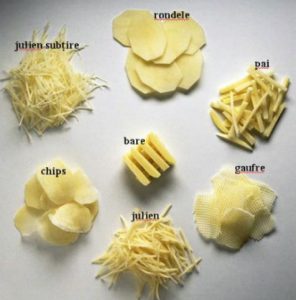
Potatoes can be cut into chips, straws, rounds, bars, julienne, waffles
|
Primary processing represents the first operations performed on the raw materials used to obtain the soups and consists of removing the inedible parts, sorting, washing, cutting, slicing, scraping, grinding the raw materials. The technological phase of primary processing is carried out in specially designed and equipped production spaces called preliminary processing sections. THE VEGETABLES Following the preliminary processing of vegetables, quantitative differences result, known as household losses and qualitative losses. Cleaning aims to remove foreign bodies, inedible or indigestible portions. These operations are performed manually (with special knives), mechanically (with cleaning equipment) or thermally (by scalding). Cutting is done differently, depending on the dish for which the vegetables are used and is performed with a vegetable knife, chef’s knife or food processor . Root vegetables can be cut into bars, julienne, spheres, barrels, thin slices, cubes, rounds, triangles, ovals, rhombuses. Potatoes can be cut into chips, straws, rounds, bars, julienne, waffles. Onions can be cut into thin slices, rounds, rings, small fishes, small pieces. Tomatoes, peppers, cucumbers and other fruit vegetables can be cut into slices, rings, bolts, quarters. Cabbage can be chopped, cut into strips or whole. Cauliflower and broccoli break into florets. Mushrooms are cut into quarter or slices. Green vegetables are cut thinly or pieces. EGGS are washed, disinfected, rinsed and broken, after which they can be beaten with a whisk, the white can be separated from the yolk and beaten separately. FISH is cleaned of scales, eviscerated, washed, cut off the head, after which it can be sliced or filleted. BUTCHER MEAT is washed, deboned, cleaned of inedible parts and sliced (with butcher knives), after which the types of meat that can be cut into large pieces, cubes, slices and can be hammered with a butcher’s hammer or can chopped. The POULTRY is cleaned of the inedible parts, flambéed, sliced and can be cut into pieces or slicedand pounded with a mallet. The BUTTER is melted or smoothed. TELEMEA CHEESE AND CHEESE is cleaned of the outer layer and can be cut into slices, bars, cubes, large pieces or grated. |
|
THERMAL PROCESSES CARRIED OUT WHEN SOUPS ARE OBTAINED Partial thermal processes are carried out on the ingredients in the soups so that they soften faster and acquire a special color and taste. Most of the time, onions are fried, sauteed or stewed in fat. Vegetables and meat can also undergo processes of sauteing or boiling in their own juice with the addition of water from time to time (thermal stewing process) before being introduced into boiling, which is the main thermal process in making soups. Tomatoes and meat can also be scalded before boiling. The partial thermal processes are carried out in pans or saucepans and the boiling process in pots of various sizes, these being placed on gas or electric cooking machines. Scalding is a short-term process of placing the food in a saucepan or pot with water at relatively low temperatures (80 – 90 oC) maximum 100 oC in order to remove the outer covering of the vegetable and fix the color. Boiling consists of placing food in a pot of boiling water or cold water and raising the temperature to 100 *C, with the aim of softening the texture of the vegetables and the tissue of the meat to become edible. Steaming is boiling in superheated vapors and consists of putting the vegetables in a small amount of fat and an equal amount of hot liquid (water or soup) in a covered vessel (pan, saucepan), making a boil in its own juice, until the product is well penetrated. Frying takes place in the absence of water and consists of putting food into hot fat in a pan (at boiling temperatures). Sautéing consists of quickly frying food in a small amount of fat, in an open vessel without a lid (pan or saucepan), on high heat, for a short time. OTHER OPERATIONS PERFORMED WHEN OBTAINING SOUPS Some soups have a sour taste because acidifying elements are added (cabbage juice, borscht, tomato paste, tomato juice, broth, lemon juice, lemon salt, vinegar, yogurt, whey, raw fruit puree) which add 10 minutes before the end of cooking for a better taste and appetite. Soups made with fatty pork or poultry are defatted by spooning off the fat from its surface for a more attractive appearance, others are strained to remain clear, and other soups are thickened with mixtures of egg yolk, flour and cream or fried flour mixed with a little liquid (soup, tomato juice, milk) to give soups a greater consistency but also a better taste and higher nutritional value. They are creamy soups that are obtained by pureeing or blending the ingredients until a cream is obtained that bears the name of the ingredient added in the largest amount. The pureeing is done with the strainer and the blending with the blender. The role of the pureeing or blender is to obtain a different assortment of soups, to be easy to eat (by children and the elderly), and the nutrients in the ingredients are absorbed more easily. Additions in the form of noodles, noodles, flour or semolina dumplings, flour pasta are added to clear soups to increase the energy value. Enjoy the mod! |
Knowledge: Students know and describe the operations of cleaning and cutting raw materials as well as the utensils and equipment used in the execution of these operations.
Students list and describe the thermal processes of cooking as well as the utensils and equipment used in the thermal process.
Skill: Students clean and cut raw materials to obtain liquid preparations, using the appropriate utensils and equipment.
Students perform heat treatments on raw materials to obtain liquid preparations, using appropriate vessels and equipment.
Attitude: Students respect the principles of sustainable development in primary and thermal processing or performing other operations on the ingredients used to obtain liquid preparations through the safe and efficient use of kitchen equipment
Responsibility: Students perform operations and use utensils and equipment responsibly in the order specified in the recipe to prepare the soups.
The description
Listing
Compare
Analyze
Documentation
Validation and recognition through testing and feedback
For example: During the lesson you have to read the written explanations, the pictures, watch the videos and follow the instructions given in the tasks.
Cutting skills and other essential techniques for preparing ingredients
Primary vegetable processing operations
Watch the five youtube videos you find at resources. For each movie is a corresponding question below. Answer the questions.
- In what ways did chef cut the root vegetable?
- What are the ways of cutting green vegetables?
- What cutting techniques did Chef use for mushrooms and in what ways did he cut them?
- In what ways did Chef cut the tomatoes and what knives did he use for cleaning the inedible part and for cutting into various shapes?
- How was the cleaning of the inedible parts of the cabbage carried out?
In what ways was cabbage cut?
https://www.youtube.com/watch?v=zIsHkNor6nohttps:/
/www.youtube.com/watch?v=DKorRlpLEcM
https://www.youtube.com/watch?v=9ioiVbtQQb4
https://www.youtube.com/watch?v=HFovcq3OLyc
Butchery and poultry primary processing operations
1.Watch the first video from helpful links showing how to cut pork leg and read how to cut butcher meat from the welcome note. Specify the ways of cutting the pork leg made by the chef from those presented in the welcome note.
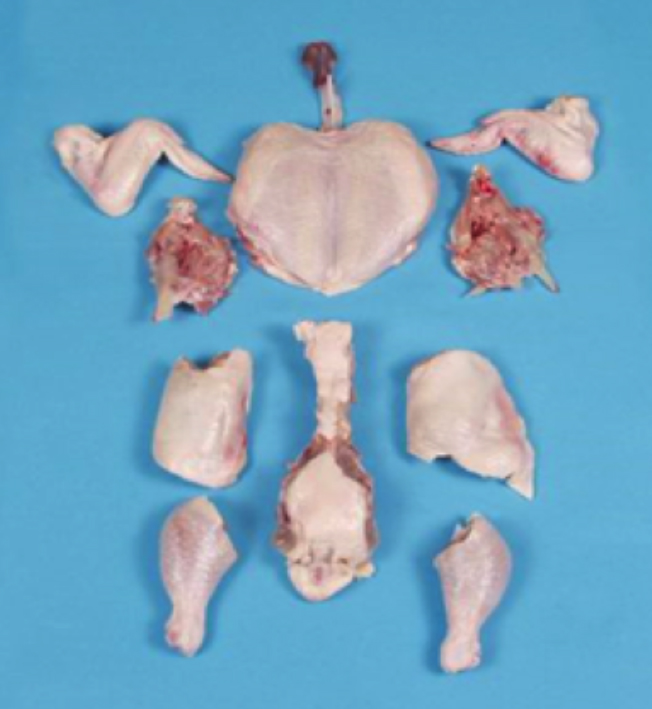
- In the picture below are the parts resulting from slicing the poultry meat. List the anatomical parts of the chicken that result from cutting.
Primary processing of fish meat
In the images below there are four operations performed on the fish.

1.Write the number corresponding to each image and next to the number the name of the operation.
2.List three fish processing operations shown in the pictures, in the order in which they are performed.
https://www.instructables.com/Preparing-a-Whole-Fresh-Fish/
https://www.fao.org/3/w0495e/w0495E03.htm
Different cooking methods used to create different types of soups
Heat treatments for soups
Thermal treatments applied to food to obtain soups are various. Five basic rules for cooking soups are described in the video in the link. Answer the questions.
In the film, the two chefs present three thermal treatments that are applied to the ingredients to obtain the soups.
- What are the three thermal treatments?
What is the purpose of the three heat treatments on the ingredients?
https://www.realsimple.com/food-recipes/cooking-tips-techniques/best-soup-stew-tips-tricks
Additional operations in making soups to diversify them
In the table below are listed the names of additional operations when making the supelot and next to them the role. In the third column mark with YES or NO the matching of the additional operation with the role and if the answer is NO then write in the fourth column the role corresponding to the operation.
|
Additional operation |
Role |
YES/NO |
Role corresponding |
|
Addition of acidifying element |
More attractive appearance |
||
|
Addition of noodles, noodles, flour or semolina dumplings, flour pasta |
Increases the energy value |
||
|
Breaking |
Higher consistency, better taste and higher nutritional value of soups |
||
|
Pureeing/ blending |
Getting a different assortment of soups, soups easier to eat, nutrients in the ingredients are absorbed more easily. |
||
|
Thickening with mixtures of egg yolk, toasted flour, cream, milk, broth |
Rinse aid |
||
|
Degreasing |
A better taste and the opening of the appetite |
https://www.bbcgoodfood.com/howto/guide/how-thicken-soup
Vessels used for various partial and total heat treatments in making soups
Correlate the numbers in column A in which the heat treatments applied to the ingredients in obtaining the soups are entered and the letters in column B in which the vessels in which these heat treatments are carried out are entered.
|
A |
B. |
|
1. Sauté 2. Boiling 3. Steaming 4. Frying 5. Scalding |
b. Frying pan with lid c. Frying pan without lid d. Saucepan with lid Saucepan without lid |
Valentina Capotă and co., Tourism and food, textbook for class X, CD Press publishing house, Bucharest, 2011
Learning outcomes/outcomes (ECVET)
|
Knowledge |
Abilities |
Attitude |
Responsibility |
|
– Enumeration of primary processing operations of raw materials, utensils and equipment used for cleaning, cutting of ingredients required for liquid preparations – Description of primary processing operations (cleaning, cutting and others) of raw materials used in liquid preparations. |
– Performing the primary processing operations of the raw materials used in the liquid preparations with utensils and equipment in the order of the recipes |
Compliance with the principles of sustainable development in the primary processing of ingredients used to obtain liquid preparations through the safe and efficient use of kitchen equipment |
– Students perform cleaning, cutting or other primary processing operations of raw materials to make liquid preparations responsibly, using the appropriate techniques, in the order specified in the recipe, with the appropriate utensils and equipment |
|
-Enumeration of thermal processing operations applied to the ingredients used in making liquid preparations -Description of thermal processing operations for making liquid preparations |
-Carrying out thermal processing operations respecting the rules underlying their realization |
– Responsible involvement in the thermal processing operations of raw materials in order to obtain liquid preparations through the safe and efficient use of thermal processing equipment, respecting the principles of sustainable development |
– Students perform thermal processing operations using equipment, dishes and utensils in compliance with labor protection norms and the technical rules that must be respected
|


